
by Surrounded by Idiots, Thomas Erikson
Summary:
Daily misunderstandings stem from a connection problem rather than a communication issue. Drawing on behavioral science and the four-color personality framework, Erikson shows how individuals interpret the same words through completely different perception lenses.
Watch this video to get full story:
Full Text of video for those who would prefer to read it (AI generated)
Why People Misunderstand You (Even When You’re Being Clear)
A Comprehensive Guide to Communication vs. Connection
1. Communication vs. Connection
The Core Problem
We often tell ourselves that we have a communication problem, but the reality is that we have a connection problem.
Communication is about transmitting information.
Connection is about achieving understanding.
The gap between information and understanding is where most daily misunderstandings, friction, and frustrations occur.
Real-World Example: The Stockholm Leadership Team
During a coaching session with a corporate management team in Stockholm, a decisive, action-oriented CEO kept insisting:
"We need more speed! We're moving too slowly."
The introverted team members completely froze.
The CEO’s intent: Inspire fast action and momentum.
The Team’s interpretation: An announcement of panic and crisis.
The team understood the words perfectly fine—there was no communication breakdown. The failure occurred entirely at the level of connection.
What Research Tells Us
MIT Human Dynamics Lab: The primary predictor of high-performing teams is not individual IQ, technical skill, or message clarity. It is the quality of social connection—measured by tone of voice, eye contact, and the rhythm of back-and-forth interaction.
Harvard Study of Adult Development: The single strongest predictor of long-term human health and well-being is the quality of our relationships and the feeling of relational safety.
2. Efficiency vs. True Understanding
The Pitfall of Productivity Worship
In modern work environments, speed, scale, and productivity are frequently prioritized over depth. However:
Communication without connection is like Wi-Fi without internet—technically connected, but nothing is actually flowing through.
The Modern Dilemma
In our digital era, we are constantly broadcasting:
Sending endless emails to confirm previous emails.
Adding slides to presentations.
Using emojis to soften tone.
This creates "synchronized talking"—where people take turns broadcasting information without anyone actually receiving or processing it.
Emotional Malnutrition
Ending a workday feeling completely drained is often not caused by overwork, but by under-connection. Faking engagement and performing active listening without genuine comprehension creates emotional exhaustion.
3. Human Compatibility & Perception Lenses
The Radio Frequency Analogy
Most conflicts do not stem from poor articulation, but from viewing reality through different perceptual lenses. Communication relies on compatibility, not just clarity.
If you broadcast on 103.2 FM and the listener is tuned into 98.7 FM, you can articulate your message with absolute clarity, but all the listener will hear is static.
The Curse of Knowledge
Psychologists define the Curse of Knowledge as the difficulty of imagining what it is like not to know something once you already know it.
Meaning is never simply sent through words.
Meaning is reconstructed in the mind of the listener based on their personal experiences, fears, background, and current mood.
Differing Translations
A simple statement like "Let's move fast" carries radically different meanings depending on the recipient:
To an action-driven person: Signals opportunity, energy, and momentum.
To a cautious analyst: Signals chaos, recklessness, and impending error.
Repeating yourself louder or adding more detail fails because you cannot fix an emotional distortion using a purely logical tool.
4. False Consensus & Personality Lenses
The False Consensus Effect
We naturally fall victim to the belief that most people think, process, and view the world the same way we do. When others disagree, our default assumption is often that they are being unreasonable or obstructionist.
The Behavioral Framework
Using the Surrounded by Idiots framework, human behavior can be understood through four primary lenses:
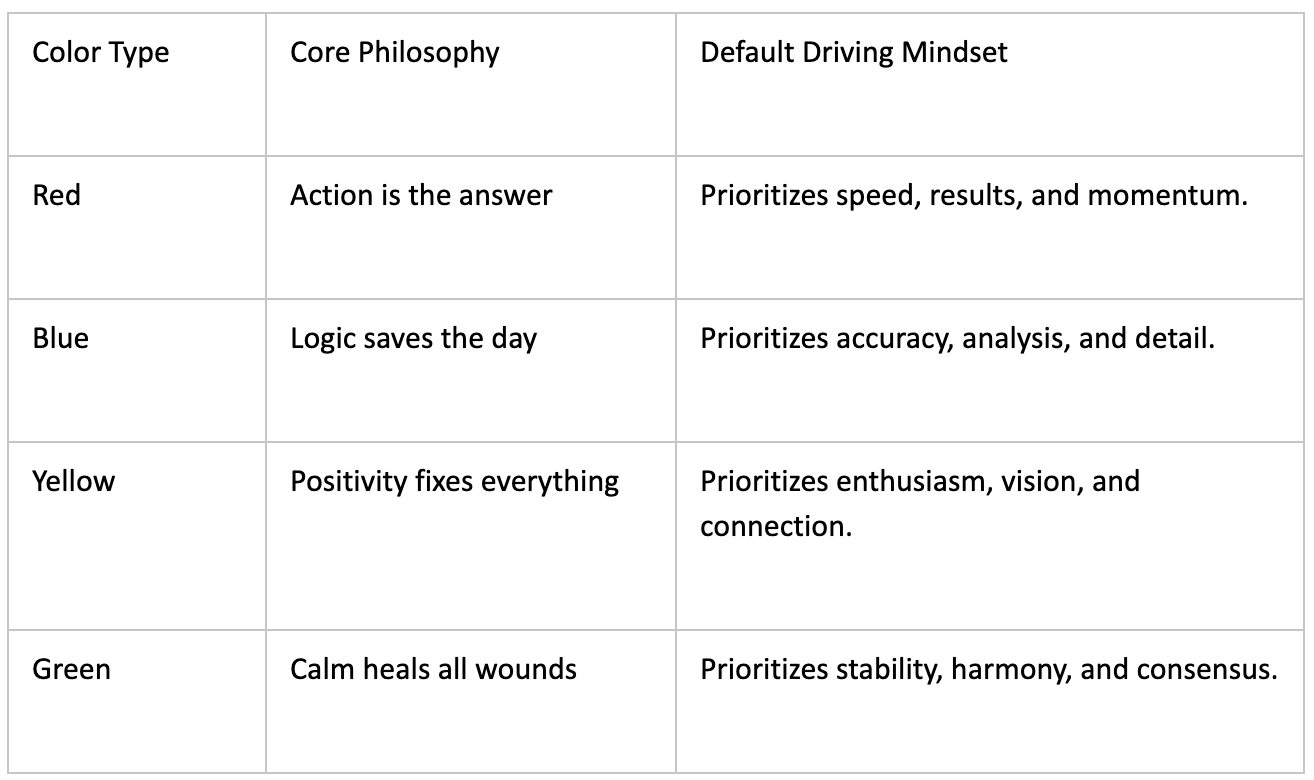
Defending Identity Over Facts
When a conflict escalates, people are rarely arguing about objective facts. Instead, they are defending their identity, values, and sense of self-worth. Challenging someone’s approach feels like an attack on their intelligence or competence.
5. The Science of Curiosity
Curiosity Before Correction
When misunderstandings occur, the natural impulse is to correct the other person ("Let me explain why I'm right"). However, true connection requires choosing curiosity before correction:
"Help me understand why this makes sense to you."
The Neuroscience of Curiosity
Research from the University of California shows what happens in the brain during curious interaction:
Dopamine Release: Curiosity activates the brain's reward system, releasing dopamine and stimulating learning and motivation.
Prefrontal Cortex Activation: The prefrontal cortex (responsible for empathy and analytical reasoning) turns on.
Amygdala Deactivation: The amygdala (responsible for the fight-or-flight response, fear, and defensiveness) quiets down.
Curiosity shifts the human nervous system out of attack mode and into attach mode.
6. Shared Language Restores Connection
Decoding Behavior Patterns
Curiosity becomes sustainable when paired with a structured way to interpret behavior. Understanding patterns helps us depersonalize actions:
A colleague interrupting in meetings is often driven by urgency or thinking out loud, not disrespect.
A teenager retreating into their room is often protecting their energy, not rejecting the family.
The Power of Shared Vocabulary
Just as pilots use standardized terminology or musicians read the same musical sheet, adopting a shared behavioral language transforms conflict into collaboration.
Having a common framework:
Removes Blame: Behavior is treated as an observation rather than an accusation.
Creates Safety: People feel secure expressing differences without fear of judgment.
Fosters Harmony: Conversations become lighter, meetings grow shorter, and mutual understanding increases.